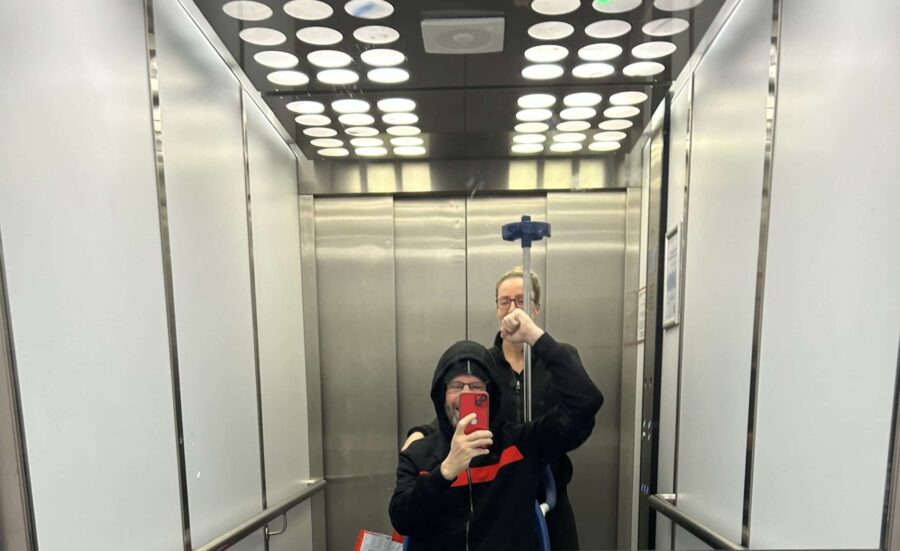
My recovery has been far more than simply getting fit again it’s been a complete physical, mental and personal reconstruction.
It began with emergency surgery following a perforated bowel caused by diverticulitis. Twelve days later I underwent a second major operation a Hartmann’s procedure which left me with a permanent stoma for the time being. Between both surgeries I spent five days in ICU, had approximately 1.5 litres of infected fluid drained from my abdomen, underwent a six-and-a-half-hour operation, was left with around 30 surgical staples, developed fluid on my lungs and lost roughly 30 pounds in bodyweight. At that stage, survival was the only objective.
The first phase of recovery focused purely on healing. Walking short distances, managing the stoma, rebuilding confidence and coping with the psychological impact of such a life-changing event became my full-time job. I also developed a parastomal hernia, meaning every stage of rehabilitation had to be carefully managed and progressed conservatively.
Once my surgeon cleared me to begin training again, I approached rehabilitation exactly as I would coach a high-performance client with structure, measurement and patience. I rebuilt movement quality before strength. Mobility work, breathing, activation drills, walking and fundamental movement patterns became the foundation before gradually introducing resistance training.
From there I progressed into rebuilding strength. Every increase in load became a milestone rather than simply another workout. My focus wasn’t chasing numbers but proving that my body could become resilient again. I developed my own recovery philosophy through the S.T.O.M.A. Operating Systems
Simple
Training
Organised
Manageable
Activity
Then into the later performance development stages it became
Strength
Tenacity
Organisation
Mastery
And Accountability
which gave me a framework for both physical rehabilitation and life after major trauma.
As my strength returned, so did my identity. I moved from
survival to healing to recovery and rehabilitation then into performance development. By that point I had returned to regular resistance training, progressively increased training volume and intensity, rebuilt cardiovascular fitness, regained muscle mass and consistently tracked my progress through structured performance reviews, training journals and recovery metrics.
Alongside the physical recovery came significant mental and emotional growth. The experience reinforced my appreciation of health, relationships, purpose and service. I’m definitely a work in progress but I feel that I have improved my key relationships and I am a very different person now especially in my emotional and spiritual fitness
This journey has also strengthened my coaching philosophy, leading me to further develop frameworks including the Four Pillars of Conscious Performance and my wider coaching models. Rather than simply returning to where I was before surgery, I used the experience to become a better athlete, coach and a more resilient and robust person.
Today, I continue to train while successfully managing life with a stoma and parastomal hernia. My focus has shifted from recovery to long-term performance, longevity and becoming an example of what is possible after major surgery. The journey has demonstrated that rehabilitation is not about returning to your previous normal it is about creating a stronger one.
The progression has been clear:
Stage 1 – Survival: Emergency surgeries, ICU, infection control and simply staying alive.
Stage 2 – Healing: Wound recovery, learning to live with a stoma, regaining independence and rebuilding confidence and renewing my core values and identity
Stage 3 – Rehabilitation: Mobility, walking, core stability, movement quality and gradual reintroduction of exercise.
Stage 4 – Strength Rebuilding: Progressive resistance training, increasing work capacity and restoring physical capability while respecting the hernia.
Stage 5 – Performance Development: Returning to structured strength training, setting post-surgery personal bests, rebuilding fitness and consistently improving objective performance markers.
Stage 6 – Transformation: Turning lived experience into coaching principles, developing new performance frameworks and using the journey to inspire others facing adversity.
Looking back, the greatest achievement wasn’t a particular lift or performance milestone. It was proving that we can turn pain into purpose and tragedy into triumph and that a catastrophic illness doesn’t have to define the future.
With patience, structure, discipline and purpose, it is possible not only to recover but to build a stronger life than existed before.
—————————————————
What is an emergency Haartman’s procedure?
An emergency Hartmann’s procedure is a life-saving operation performed when the large bowel has become severely diseased or perforated, most commonly due to conditions such as diverticulitis, bowel cancer, trauma or obstruction. During the surgery, the damaged section of the colon is removed, the healthy end of the bowel is brought through the abdominal wall to form a stoma (colostomy) so waste can safely leave the body into a colostomy bag, and the remaining lower section of the bowel (the rectal stump) is sealed and left inside the abdomen. The procedure is usually carried out in critically ill patients when it is too dangerous to reconnect the bowel immediately because of infection, inflammation or instability. In some cases, the stoma can be reversed after recovery, although for others it may become permanent depending on their overall health and the condition of the bowel.